Cloud Based Battery Management System (BMS)

The rapid growth of electric vehicles (EVs), renewable energy systems, telecom backup units, and industrial energy storage solutions has increased the demand for intelligent Battery Management Systems (BMS). Traditional standalone BMS architectures are limited in terms of scalability, predictive analytics, remote monitoring, and centralized fleet management.

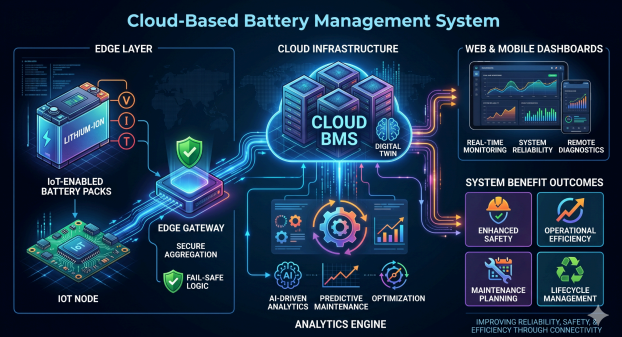
This case study presents the design, implementation, and deployment of a Cloud-Based Battery Management System capable of real-time monitoring, analytics, predictive maintenance, remote diagnostics, and energy optimization. The solution integrates IoT-enabled battery nodes, edge gateways, cloud infrastructure, AI-driven analytics, and web/mobile dashboards.

The proposed architecture demonstrates how cloud connectivity improves battery safety, operational efficiency, maintenance planning, lifecycle management, and overall system reliability.
Start with One Machine Request a Demo

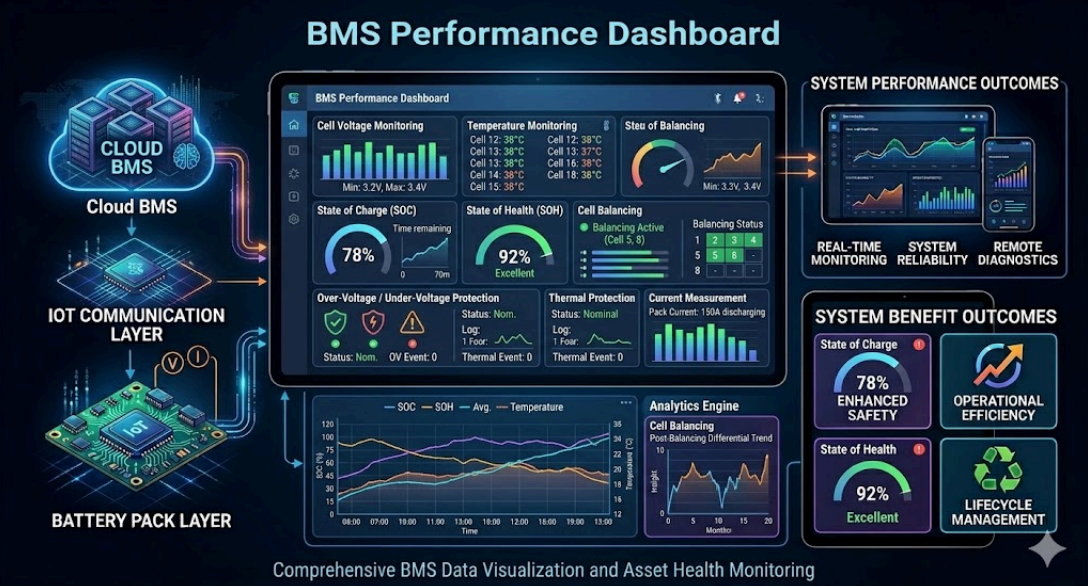
Battery Management Systems are responsible for monitoring, protecting, and optimizing rechargeable battery packs. A conventional BMS generally performs


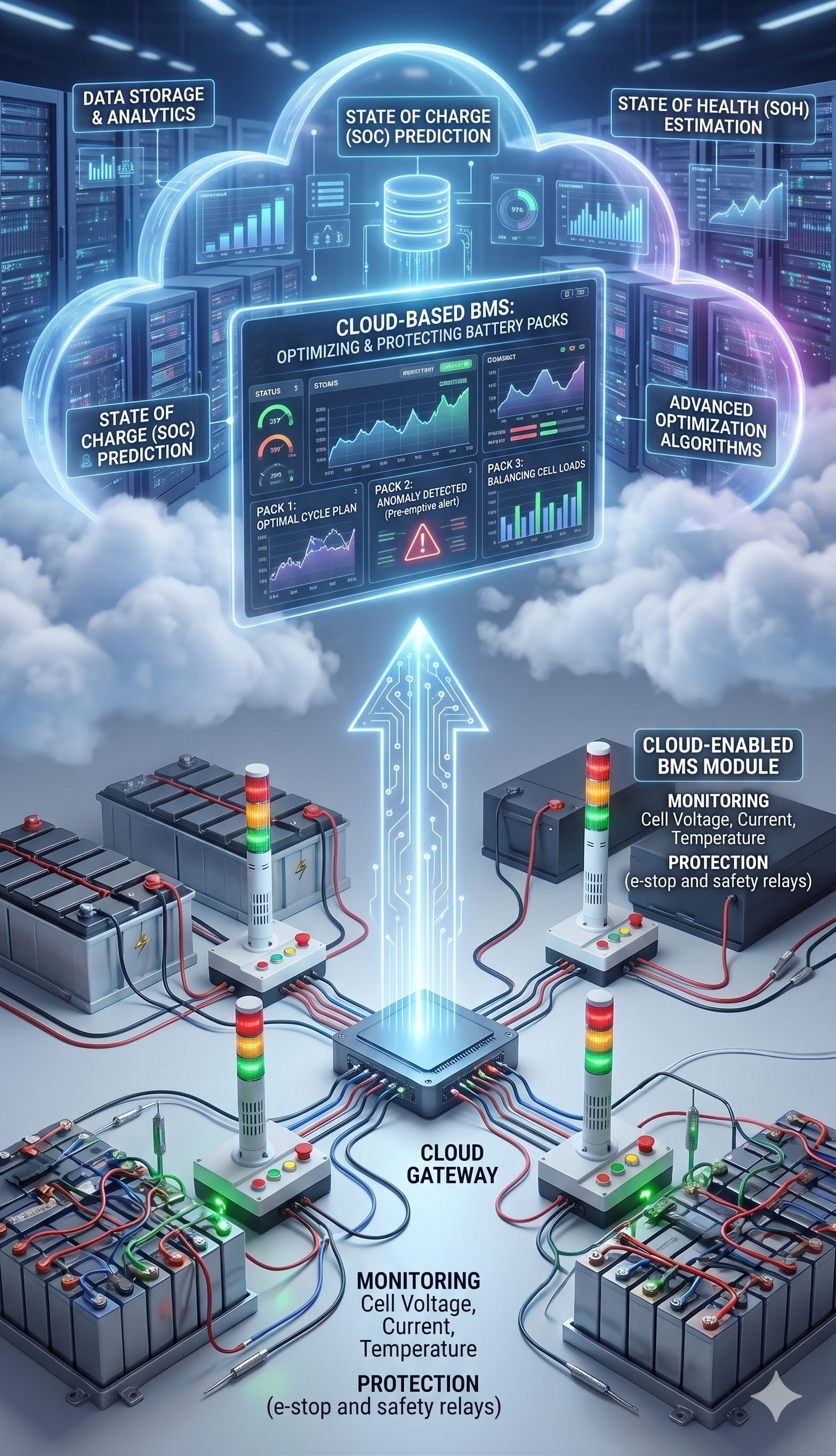
A cloud-based BMS overcomes these limitations by integrating IoT communication and cloud computing.
● Cell voltage monitoring
● Temperature monitoring
● State of Charge (SOC) estimation
● State of Health (SOH) estimation
● Cell balancing
● Over-voltage and under-voltage protection
● Thermal protection
● Current measurement

However, conventional BMS systems are often isolated and lack:
● Remote diagnostics
● Fleet-level analytics
● Predictive maintenance
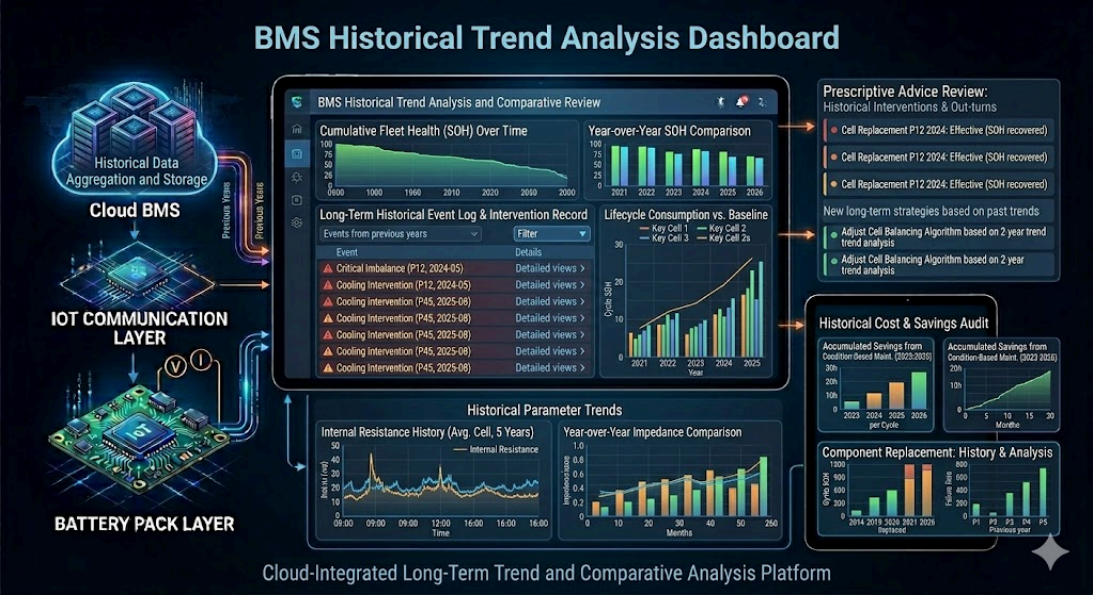
● Historical trend analysis
● Cloud data storage
● AI-based optimization
● OTA firmware updates


Problem Statement

Traditional battery systems face several operational challenges

Challenge Description
Limited Visibility Operators cannot monitor battery health remotely
Unexpected Failures Battery failures occur without warning
Manual Maintenance Requires frequent on-site inspection
Data Loss Historical battery performance is not stored efficiently
Poor Lifecycle Management Difficult to predict battery degradation
Inefficient Energy Usage Lack of intelligent optimization
Scalability Issues Hard to manage thousands of battery packs
These limitations result in:
● Increased operational costs
● Downtime
● Reduced battery lifespan
● Safety risks
● Poor energy efficiency


Objectives

The major objectives of the cloud-based BMS are

Enable real-time remote battery monitoring
Improve battery safety and reliability
Implement predictive maintenance analytics
Store battery data securely in the cloud
Provide centralized dashboard access
Reduce maintenance costs
Increase battery lifecycle
Support scalable multi-site deployment
Enable AI/ML-based battery performance analysis
Provide remote firmware and configuration updates


System Architecture

Architecture Flow

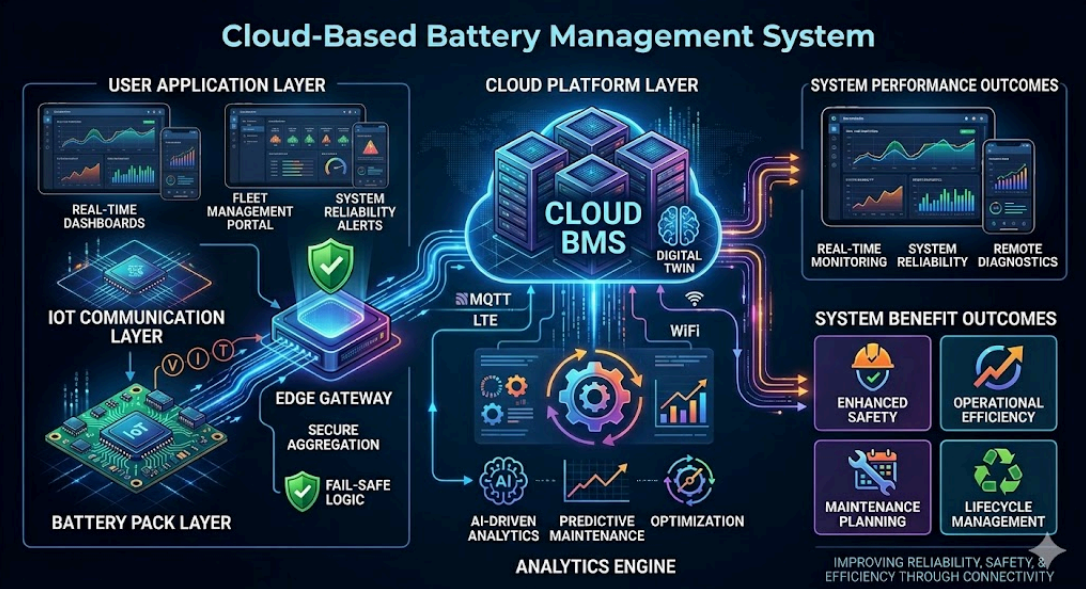
Battery Cells → Embedded BMS Controller → IoT Gateway → Cloud Server → Web/Mobile Dashboard

High-Level Architecture
The cloud-based BMS architecture consists of five major layers:
● Battery Pack Layer
● Embedded BMS Layer
● IoT Communication Layer
● Cloud Platform Layer
● User Application Layer


Working Principle

Step 1: Data Acquisition
Sensors continuously monitor:
● Cell voltage
● Pack voltage
● Current
● Temperature
● Charge/discharge cycles
● Internal resistance
The embedded controller collects data at predefined intervals.
Step 2: Local Processing
The BMS firmware performs:
● Fault detection
● SOC estimation
● SOH estimation
● Cell balancing
● Safety protection

If abnormal conditions occur, the BMS triggers:
● Relay cutoff
● Alarm notification
● Emergency shutdown
Step 3: Cloud Communication
Data is transmitted using:
● MQTT
● HTTPS
● WebSocket
● CAN-to-cloud gateway

Communication technologies include:
● Wi-Fi
● LTE/4G/5G
● Ethernet
● LoRaWAN
Step 4: Cloud Processing
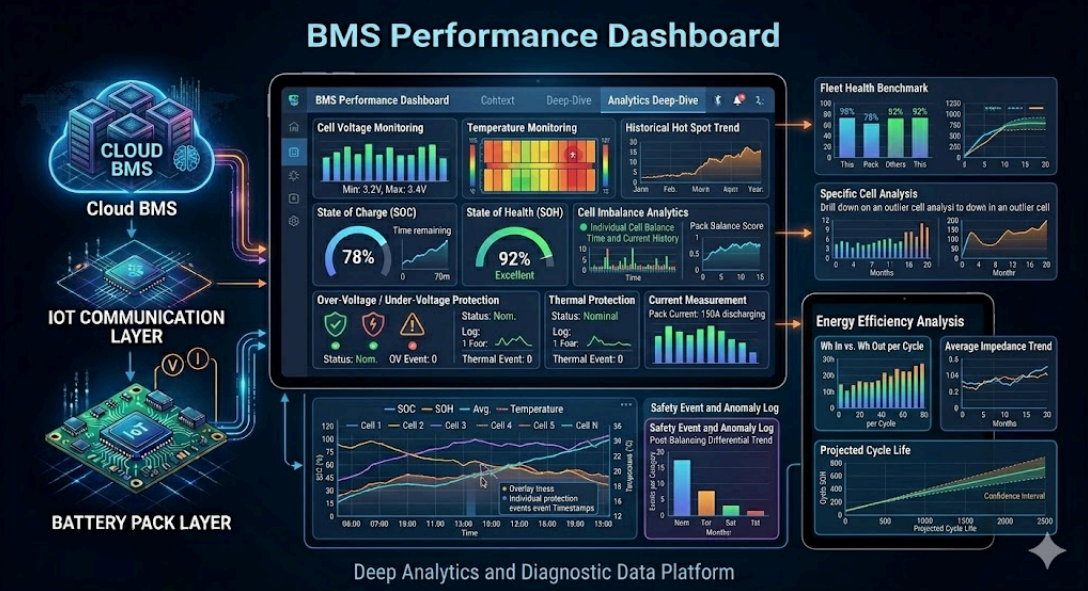
The cloud platform performs:
● Data storage
● Trend analysis
● Predictive maintenance
● Machine learning analysis
● Battery degradation prediction
● Fault diagnostics
Step 5: User Visualization
Users access the dashboard through:
● Web portal
● Mobile application
● Control room systems

Features include:
● Real-time battery status
● Alarm notifications
● Energy analytics
● Historical reports
● Maintenance recommendations

AI and Predictive Analytics

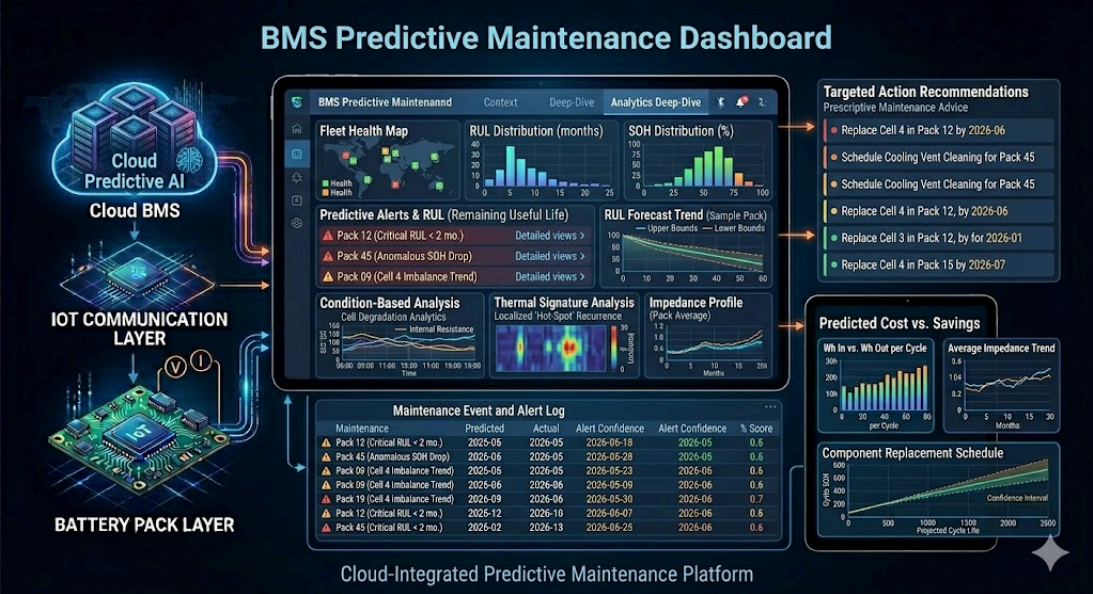
Predictive Maintenance

Machine learning models analyze:
● Temperature rise patterns
● Charge cycle behavior
● Internal resistance trends
● Voltage imbalance
● Degradation curves

Machine learning models analyze:
The system predicts:
● Remaining Useful Life (RUL)
● Failure probability
● Maintenance schedules
● Thermal runaway risk

AI Benefits

AI Capability Benefit
Failure Prediction Reduced downtime
Battery Health Estimation Improved reliability
Usage Optimization Extended battery lifespan
Smart Charging Better energy efficiency
Thermal Analysis Enhanced safety


Security Considerations

Cloud-based BMS systems must ensure strong cybersecurity protection.

TLS/SSL encrypted communication
Secure MQTT authentication
Device certificates
Role-based access control
Secure firmware updates
Firewall protection
Intrusion detection
Data encryption at rest


Use Cases

Electric Vehicles
Applications:
● EV battery monitoring
● Fleet analytics
● Charging optimization
● Remote diagnostics

Benefits:
● Increased range
● Reduced maintenance
● Improved battery safety
Renewable Energy Storage
Applications:
● Solar battery banks
● Microgrid storage
● Hybrid energy systems
● Wind Mill

Benefits:
● Efficient energy utilization
● Better backup performance
● Reduced energy loss
Telecom Towers
Applications:
● Backup battery monitoring
● Remote tower management
● Energy optimization

Benefits:
● Reduced site visits
● Improved uptime
● Faster fault detection
Industrial UPS Systems
Applications:
● Data center UPS monitoring
● Critical infrastructure backup

Benefits:
● Predictive maintenance
● Downtime reduction
● Enhanced operational continuity


Implementation Example

A logistics company deploys 500 electric delivery vehicles.

Existing Problems
● Frequent battery failures
● Unplanned downtime
● High maintenance cost
● No centralized monitorin
Implemented Solution
The company deploys:
● IoT-enabled BMS
● LTE cloud gateway
● Centralized cloud dashboard
● Predictive analytics engine
Features Implemented
● Real-time monitoring
● Battery health analytics
● Remote alerts
● GPS integration
● AI-based maintenance scheduling

Results Achieved


Parameter Before After
Battery Failure Rate High Reduced by 40%
Maintenance Cost High Reduced by 30%
Downtime Frequent Reduced significantly
Battery Lifespan 3 years Extended to 4.5 years
Monitoring Capability Manual Real-time cloud monitoring

Advantages of Cloud-Based BMS

Advantage Description
Remote Monitoring Access battery data from anywhere
Predictive Maintenance Detect failures early
Scalability Manage thousands of batteries
Data Analytics Long-term performance insights
Improved Safety Faster fault detection
Reduced Maintenance Cost Less manual inspection
Enhanced Reliability Better operational performance
OTA Updates Remote firmware upgrades


Key Outcomes

The cloud-based BMS implementation delivers

Intelligent battery monitoring
Enhanced operational efficiency
Reduced maintenance expenditure
Increased energy reliability
Improved safety management
Scalable fleet-level monitoring
Real-time decision making
AI-enabled predictive analytics